Queen of Faces by Petra Lord
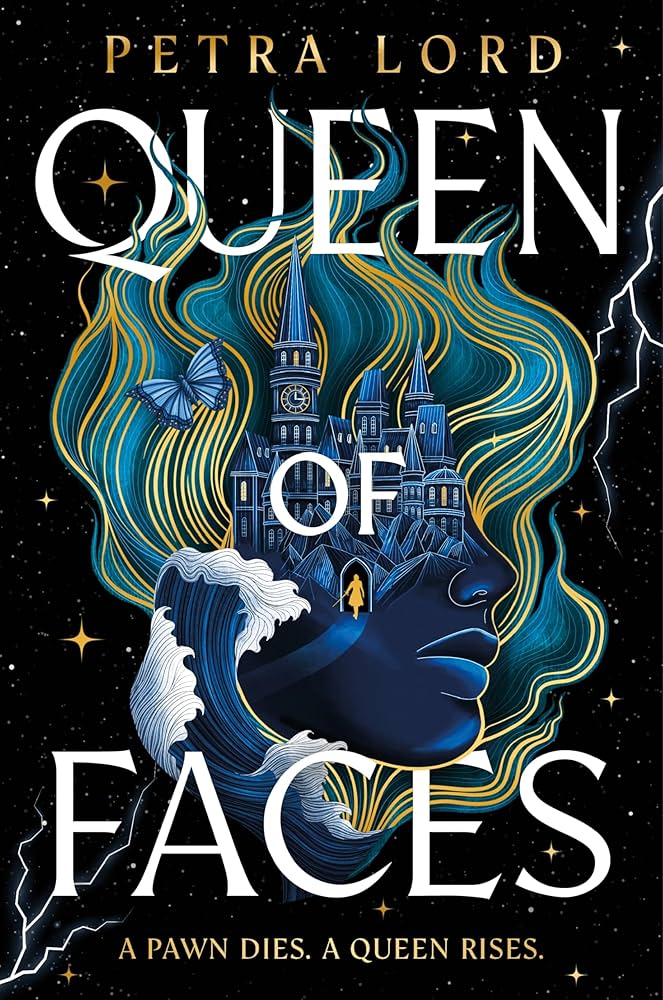
This dark academia, queer, dystopian/fantasy novel is absolutely breathtaking. While the body swapping gave me some Cinder vibes and the initial heist had me thinking of Six of Crows, this book is unlike anything I’ve read before. I still can’t believe that this is a debut novel.
I loved the unique magic system, the world-building, and LGBTQIA+ rep. I am not part of the LGBTQIA+ community, thus I can’t speak to the accuracy of Lord’s portrayal; however, I am a school librarian with students who are trying to find themselves represented in fiction, and I felt that this was portrayed beautifully.
Queen of Faces is set in a dystopian world where class division and magical status determine the haves and the have-nots. Annabel Gage falls into the latter category. Stuck in a rotting male chassis (body) known as an “Edgar” with barely a year to live, her only hope is to gain acceptance to Paragon, the elite magical academy. If accepted, she would have a bright future, but even more importantly, access to a new healthy chassis that she could transfer her “pith” (mind & soul) into.
The narrators, Dylan Reilly Fitzpatrick, E.A. Castillo, and Nicky Endres, are phenomenal and bring depth to each of their characters. Initially, I was slightly confused when some characters changed bodies, and their narrators’ voices switched, but I believe that was a unique aspect of the audiobook and an important part of the gender fluidity of certain characters.
Although I listened to the audiobook, which clocked in at about 16.5 hours, I picked up a hardcover copy on release day. The cover of Queen of Faces is absolutely stunning, and I love the sprayed edges on the special edition.
Thank you, NetGalley and MacMillan Audio, for this advanced audiobook in exchange for an honest review. All opinions are my own.
Rebel Girls of Rome by Jordyn Taylor
The Rebel Girls of Rome by Jordyn Taylor is a heart-wrenching dual POV historical fiction novel. It transitions between the story of Lilah, a young college student who is searching for information about her grandfather’s past in Nazi-occupied Rome, and Bruna, a nineteen-year-old queer Jewish woman who is separated from her family when the Nazi’s raid the Ghetto of Rome on October 16, 1943.
I received this audiobook ARC from NetGalley and Harper Audio Children’s in exchange for an honest review. I’m a huge fan of historical fiction, but I hadn’t read any in the last year as I’ve been pursuing my school library media specialist degree. I’ve been searching for unique YA historical fiction for my school library, and this is definitely one I plan to order when it is released in July. The narration is beautiful, and Jennifer Jill Araya and Jesse Villinsky deliver a moving performance. Although I am not qualified to judge Italian accents, they sounded beautiful.
I’ve read countless novels about WWII, but this book caught my attention because it takes place in Italy after it surrendered to the Allied powers in 1943. Benito Mussolini had been ousted from power at this point, and within days of the surrender, Italy declared war on Germany. I haven’t read any books set during this period in Italian history and plan to search for some more. For those of you who are fans of history, the author’s note at the end discusses some of her research.
I was slightly frustrated during the first two chapters of the book. They weren’t slow, but I had already developed theories and was impatient to begin Bruna’s story. Because of my background as a history major, I found Bruna’s story and romantic relationship more compelling and interesting than Lilah’s. The timeline of Lilah and Tommaso’s relationship was rushed and didn’t feel authentic, although I liked both characters and did enjoy both POVs.
Overall, this was a captivating listen and one that I will order and recommend to my students. I like Taylor’s writing style and plan to move her novel, The Paper Girls of Paris, to the top of my TBR pile!
I rate The Rebel Girls of Rome 4.25 stars.
Hekate: The Witch by Nikita Gill
| An engaging retelling of a lesser covered Goddess! |
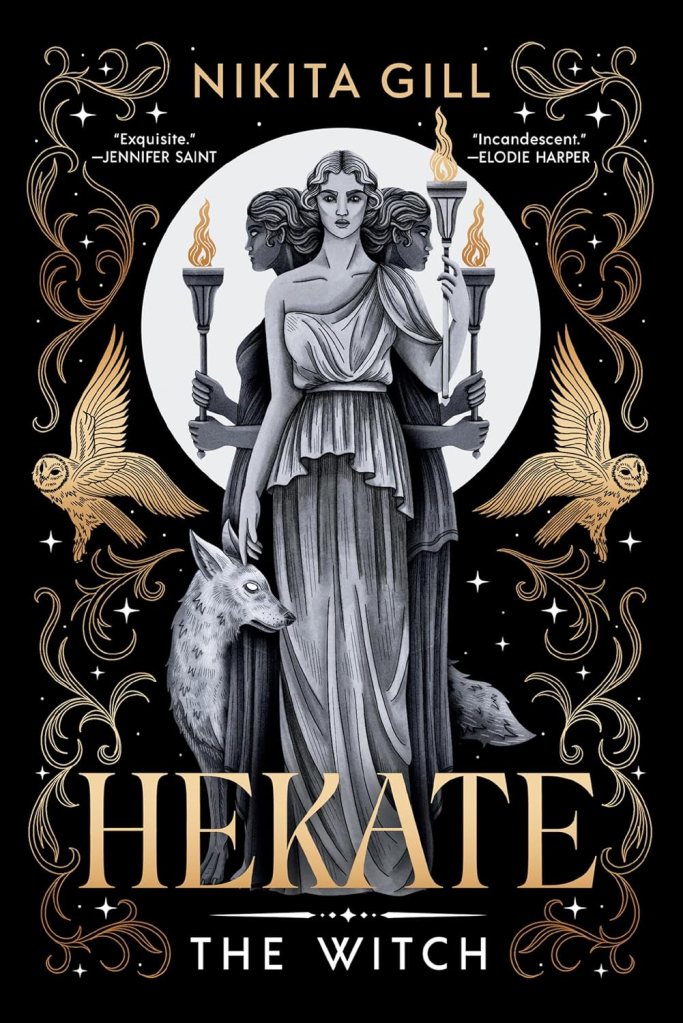
| Thank you, NetGalley and Little Brown Books for Young Readers, for an eARC of this book in exchange for an honest review! I’m a huge fan of myth retellings, and Hekate – The Witch did not disappoint. Although there are several myth retellings aimed at middle-grade and YA readers, none deal solely with Hekate. Written as a novel-in-verse, it traces the evolution of Hekate from childhood to girlhood and to womanhood. The novel starts near the end of the War of the Titanomachy, a ten-year conflict between the Titans and the Olympians. In this version, Hekate, only a child, is spirited away to the underworld by her mother to protect her from the wrath of the Olympians. In the Underworld, she is raised by Styx and befriended by Charon. This is different than most myths that say Hekate chose to align herself with the Olympians, yet this interpretation made for an interesting story. Most myths focus on Hekate’s three forms: the Maiden, Mother, and Crone, and Gill divided the novel into three stages of Hekate’s life. The three forms are also symbolic of the life cycle, moon phases, and her ability to see the past, present, and future at the crossroads. I would have liked to see more exploration of these aspects. Additionally, there was little consideration of Hekate as a witch, although the subtitle clearly references that aspect of Hekate. Despite these limitations, I loved the book and purchased it for my middle/high school library. I’ve been promoting it, and it keeps flying off the shelf! I also plan to read the other titles in the Goddesses of the Underworld series. The next title, Styx, is slated to release on September 15, 2026. |
Salvación by Sandra Proudman
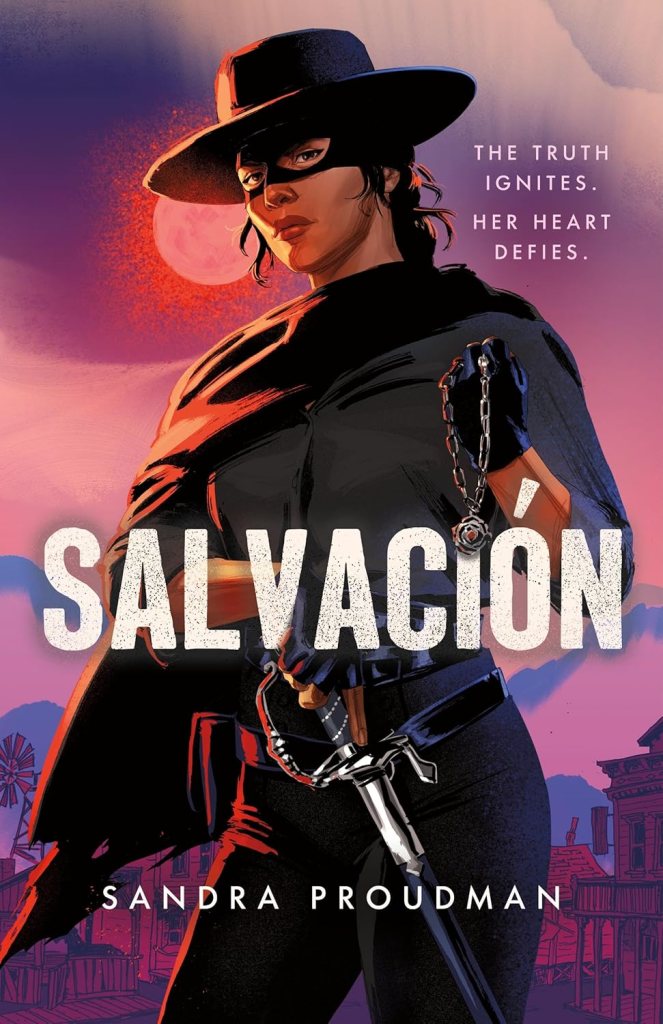
Salvación, by Sandra Proudman, is a YA fantasy inspired by the story of Zorro, the masked vigilante fictional character who was created in 1919 and based loosely on Joaquin Murrieta. I was drawn to the mysterious and strong female character on the front cover, and immediately associated her imagery with Zorro. I loved watching Zorro as a kid and was excited to read about a fierce female heroine. I liked the book, but I didn’t love it. I had high expectations and felt that the FMC, Lola de La Peña, had the heart of a warrior, but not the skill to back it up. I was excited to read a novel set in the aftermath of the 1848 Treaty of Guadalupe Hidalgo and would have loved the book to explore that more. The beginning of the story held my attention and hinted toward a lot of action, but it eventually fell flat. I expected lots of swordfights and vigilante activity, but it was minimal. Lola’s disappointment when she realizes her parents aren’t the people she thought they were is understandable. However, her musings dominate the second half of the novel, overshadowing the rest of the story. There were a few issues, the most glaring being that no one seemed to know that Lola was Salvación. I lost respect for Alejandro and the other characters for their inability to figure that out. The romance was underdeveloped, and I needed more from the relationship between Alejandro and Lola. The narrator, Victoria Villareal, delivered a strong performance in her voicing of Lola, but many of her male characters sounded similar. I’d listen to her again, though. Salvación had a lot of potential, and I’d try another Proudman book in the future. Additionally, I believe that some of my younger YA readers would enjoy this, and I will be purchasing a physical copy for my library. Thank you, NetGalley and Macmillan Audio, for the ALC
Nahia by Emily Jones
I want to thank NetGalley and RBmedia for the ARC of this audiobook by Emily Jones.
What would you do if strangers were encroaching upon the lands of your neighboring tribes, and it was only a matter of time before they reached yours? Would you stay and fight for your ancestral lands, knowing that your band had been weakened and didn’t stand a chance? Or, would you advocate for deviating from traditional values to preserve your tribe’s autonomy?
That is the challenge that Nahia is facing. Her mother is the Headwoman of the Sea People and does not want to abandon their lands, but Nahia, her successor, believes it is necessary for her people’s survival. When Nahia speaks out against her mother, it sets off a chain of events that leads Nahia to Shamanism under the tutelage of Enneko.
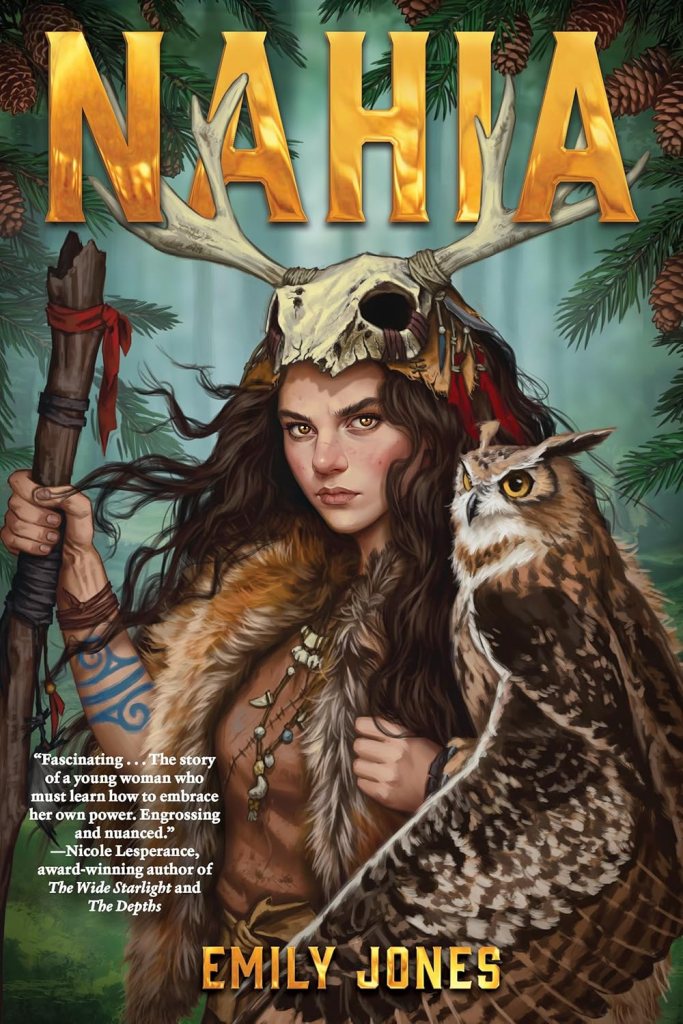
The gorgeous cover initially drew me to this book. I was intrigued by the beautiful, strong woman holding an owl on her arm, standing in front of a stunning pine forest. When reading the book description, I immediately thought of Jean M. Auel’s Clan of the Cave Bear, and was excited to listen to narrator Isabella Star LeBlanc, who was fantastic. I’d heard of her work on Angeline Boulley’s Firekeeper’s Daughter, although I haven’t listened to it myself. Additionally, Nahia appealed to me because there are very few YA novels set during prehistoric times.
Although Nahia is written for a YA audience, fans of Jean M. Auel would likely enjoy this coming-of-age story. The author, Emily Jones, is an archaeologist, and I appreciated her attention to detail and the notes at the end of the novel explaining her decision process. I spent twenty years as a history teacher before transitioning to a secondary librarian, and I am always on the lookout for good historical fiction to engage my students. I’ve already ordered a copy for next school year and plan to booktalk it early in the year.
The Library of Lost Girls by Kristen Pipps
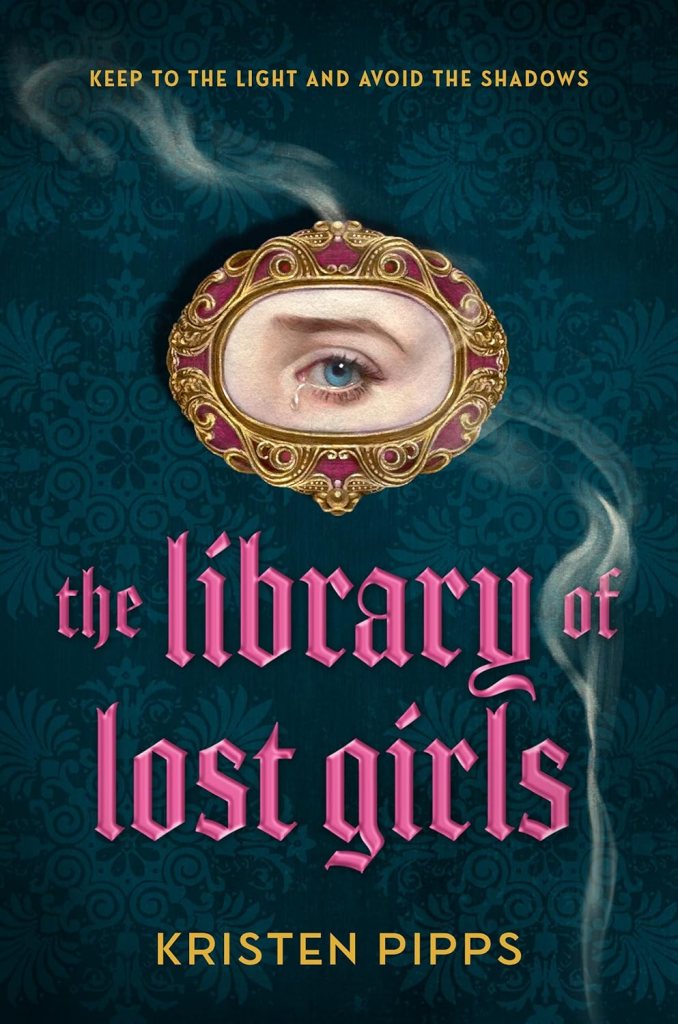
“Keep to the light. Avoid the shadows.” Gwen Donovan doesn’t know what to make of the Trustee’s cryptic warning when she is cast out of her family home and sent to the Delphi School for Girls. Months earlier, her older sister, Izzy, graduated from the same finishing school but returned a complete stranger. Although the school was meant to quell Izzy’s rebellious nature, Gwen doesn’t recognize this version of her sister, who has returned home. Determined to help Izzy and find out why she seems broken, Gwen pulls off a dramatic and crazy public stunt that results in her ‘dismissal’ the next day. Trustees escort Gwen to the school, which is hidden away on a desolate, snow-covered island. Immediately, Gwen can feel that something isn’t right at Delphi, and people make cryptic comments about “pulling out the evil.” She feels something lurking in the shadows, and she doesn’t understand why the walls are made completely from bookshelves. Can Gwen bond with the other students at Delphi and uncover what happened to her sister? Or will Gwen fall prey to the sinister presence she feels at the school?
I absolutely loved this novel. It was suspenseful, dark, exhilarating, and thought-provoking. Most importantly, it felt unique as there were plot points I hadn’t seen before. Although the title was what drew me in at the outset, I stayed for the creative world-building and character development. One of my favorite aspects of this novel was its setting. The beginning takes place in New York City in 1893, and readers are introduced to the opulence that characterized the Gilded Age, a term coined by Mark Twain. The term wasn’t a compliment, but a metaphor that alluded to the true nature of the times. Although everything looked prosperous and glittering, underneath it all festered rot and corruption. This is such a fitting setting for this novel. The combination of historical fiction, fantasy, and mystery, coupled with the fresh storyline, has moved this title to my “must” purchase list for my 6-12th grade school library.
Thank you, NetGalley and Penguin Random House, for the advanced reader copy of this novel that I received in exchange for a review. My opinions are my own.
 unapologeticallyb00kish